

AI Can't Replace Your Commercial Lawyer on the Gold Coast
Let’s get something out in the open straight away. This blog is being published by a law firm. We are obviously not a neutral party when it comes to whether you need a commercial lawyer. You might assume we have an agenda here.
Fair enough. So let us just tell you what we are actually seeing in practice, and let you draw your own conclusions.
Over the past couple of years, our commercial team on the Gold Coast has seen a significant and growing number of legal documents arrive that have clearly been drafted using AI tools, most commonly ChatGPT. We see them from clients who have prepared their own agreements. We see them, more concerningly, from other law firms. And in almost every case, they are creating problems that would not have existed if the document had been drafted properly from the start.
You Can Always Tell
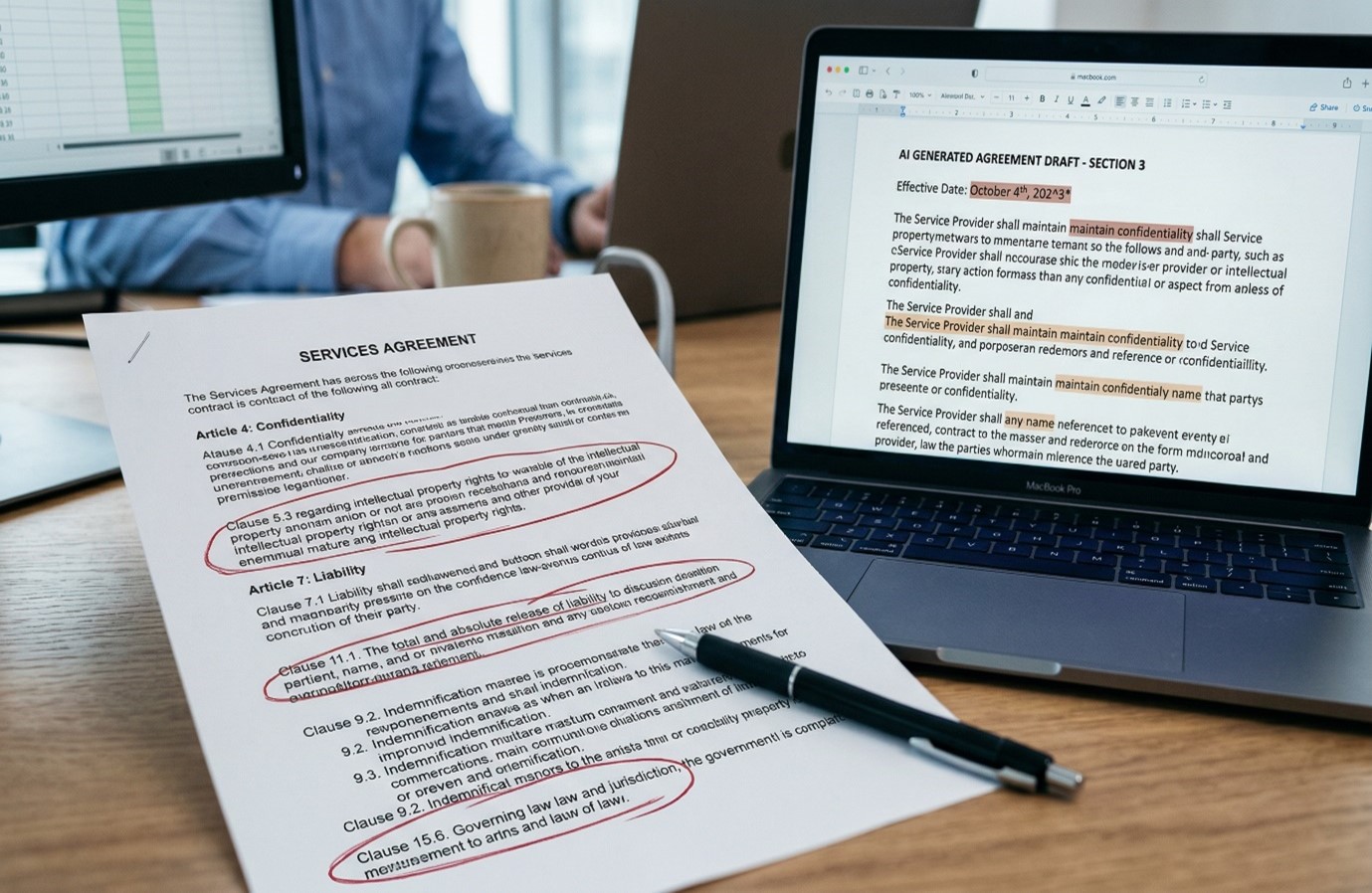
One of the first things our team noticed was how easy it is to spot an AI-drafted document, even when someone has tried to disguise it by changing the font or reformatting the layout.
The structure appears plausible at first glance. The language sounds legal. But when you read it carefully, things start to unravel. Clauses reference schedules that are not attached to the document. Defined terms are used inconsistently or not defined at all. Provisions reference legislation that does not exist in Australia, because the AI has drawn on overseas legal frameworks, commonly American or UK law, and presented them with complete confidence as if they applied here.
This is not a minor formatting issue. A contract that references non-existent legislation or undefined terms is not a legally sound document. It creates ambiguity, and ambiguity in a commercial agreement is exactly what disputes are made of.
When the AI Simply Makes Things Up
The more serious problem is what happens when AI tools are asked specific legal questions and do not have a reliable answer.
Kim Oldroyd, Director at QC Law, tested this directly. A large off-the-plan contract was submitted to ChatGPT for review, and the results were taken to a networking group to demonstrate the problem in real time. The AI identified issues with the contract that did not exist. It referred to schedules that were not in the document. When asked a specific question about how deposits worked for a large off-the-plan purchase, it provided an incorrect answer, then confirmed it when pressed, and acknowledged the error only after being directly told it was wrong.
At that point, the AI admitted something worth paying attention to: if it does not know the answer, it will construct one from whatever it can find. In legal terms, that is not a gap-filler. That is a liability.
Kim has also received correspondence from another lawyer who clearly used AI to review one of QC Law’s own lease documents. The questions raised concerned provisions that were simply not in the lease. When Kim pointed this out, the response was telling: the other lawyer had not actually read the document. They had fed it to an AI and forwarded the output.
What It Costs Clients in Practice
The cost of AI-drafted legal documents rarely shows up at the time of signing. It tends to appear later, when something goes wrong, and someone actually needs to rely on the agreement.
By that point, the document may need to be substantially redrafted or replaced entirely. The time spent untangling what the original document was trying to achieve, along with any legal fees, often costs significantly more than a properly drafted agreement would have in the first place.
We also see this play out with clients who arrive with a document they have prepared themselves using an AI tool and ask us to review it. In many cases, the review process is not straightforward because the document contains vague drafting, missing definitions, and provisions that do not reflect Australian law. It is often faster and less expensive for the client to have us draft a new document from scratch than to try to fix what is already there.
The clients who feel this most acutely are small business owners who were trying to keep costs down at the start. The intention is completely understandable. But a shareholder agreement that does not clearly set out what happens when one party wants to exit, or a subcontractor agreement that does not include a personal guarantee, or a commercial lease that the tenant signed without understanding their maintenance obligations, these are not just paperwork problems. They are financial exposures that can follow a business for years.
Where AI Tools Actually Help
This is not an argument that technology has no place in legal practice. It clearly does, and reputable legal software providers are building AI functionality into their platforms to assist with document management, precedent searching, and administrative tasks.
The distinction is between AI that assists a qualified lawyer and AI that attempts to replace a qualified lawyer.
A lawyer using well-designed legal software to help organise a matter or cross-reference precedents is using a tool. A client using ChatGPT to draft their own commercial agreement and signing it without any legal review is doing something fundamentally different. The output might look similar on the page. The legal reliability is not comparable.
Queensland law is specific. Commercial agreements need to reflect Australian consumer law, Queensland-specific legislative requirements, and the parties' actual circumstances. A general-purpose AI trained on a broad dataset of internet content is not equipped to do that reliably, and it has no professional obligation to you if it gets it wrong.
Your lawyer does.
The Questions Worth Asking
If you have received a legal document from another party and are not sure whether it has been properly drafted, there are some practical considerations to keep in mind.
Check whether defined terms are used consistently throughout. Look at whether any schedules or attachments referenced in the body of the document are actually included. If there are references to specific legislation, check that it is Australian law and that it actually says what the document implies. If something reads as vague or circular, it probably is.
And if you are not sure, ask a lawyer to look at it before you sign. A contract review is a fixed, known cost. Discovering a problem after you are bound by the document is not.
Talk to a Commercial Lawyer on the Gold Coast
At QC Law, our commercial team works with Gold Coast businesses on a full range of agreements: shareholder agreements, business purchase and sale contracts, subcontractor and contractor agreements, commercial leases, and more. Every document we prepare is drafted by a qualified Australian lawyer who understands Queensland law and takes responsibility for the advice they give.
If you have a document you are not sure about or need a commercial agreement drafted properly from the start, contact our team today.
Fixed professional fees. Real legal advice. No hallucinated schedules.
Contact QC Law: epost@qclaw.com.au | 07 5657 1928